How to Break the Cycle of Emotional Spending
You’re not lazy.
You’re not bad with money.
You’re not “just bad with impulse control.”
You’re chasing a chemical your brain is wired to crave: dopamine.
Dopamine spending — it’s not about what you’re buying. It’s about the quick hit of “feeling better” your brain is chasing.
And no — this post isn’t about shaming you for it.
It’s about helping you understand why those impulse buys happen, and more importantly, how to break the cycle that’s quietly draining your bank account, confidence, and peace of mind.

But here’s the thing:
I used to be the poster child for emotional spending, I couldn’t go more then 3 days without buying something new. But over the past three years, I’ve completely shifted my relationship with money, spending, and self-worth. I’ve tripled my savings, decluttered my home, built a more meaningful life, and stopped buying the cheap, trendy things I didn’t even really want — all without a raise or side hustle.
In this post, I’m not just sharing a wake-up call.
I’m giving you the exact framework I used to stop chasing cheap dopamine and start spending with purpose.
And the best part?
You don’t have to be perfect. You just need a starting point.
This is yours.
Let’s break the cycle—together.
What is Emotional spending
Emotional spending is when you buy something—not because you actually need it—but because you’re trying to shift how you feel. You’re tired, stressed, bored, or just craving something to lift your mood. So you reach for the fastest fix: hitting “add to cart.”
And let’s be real—it does feel good.
That little rush? That’s dopamine.
It’s not the item itself that’s addictive.
It’s the feeling.
The quick hit of excitement. The temporary high.
That’s why I often call emotional spending what it really is: dopamine spending.
Your brain is wired to chase short-term rewards, especially when you’re overwhelmed or running on empty. So the idea of a small treat, a sale find, or a quick online splurge becomes super tempting because for a moment, it makes everything feel lighter.
Rough day at work? Lonely night in?
Swipe. Click. Purchase.
But here’s the catch: the joy fades fast… and what’s left is often guilt, clutter, and a bank account that’s not moving toward what you actually want.
This isn’t about willpower.
It’s about learning how to recognize those emotional spending patterns—so you can start making choices that actually feel good long-term, not just in the moment.
Identify Your Triggers
Let’s be real: emotional spending rarely shows up out of nowhere.
So ask yourself, What is my triggers?
It usually sneaks in after a long week, when you’re exhausted, overwhelmed, or just done. Do you spend more after a rough week and find yourself scrolling late at night. You’re lying in bed, scrolling, and suddenly something cute pops up.
And your brain says, “You’ve worked hard—you deserve a little something.”
Do you click “add to cart” if you have a fight with your boyfriend?
Do you get more tempted when store have sales? Because anything you get on sales your technically saving money, right!
For me, that was my biggest trigger. What can I say, I love a good deal or a gift with purchase. And having work in retail for almost 20 years I know how to spot them.
This isn’t bad behavior.
It’s your brain trying to feel better the fastest way it knows how: dopamine.
But then?
The high wears off.
The guilt shows up.
And your dream savings goal feels even further away.
It often looks like this:
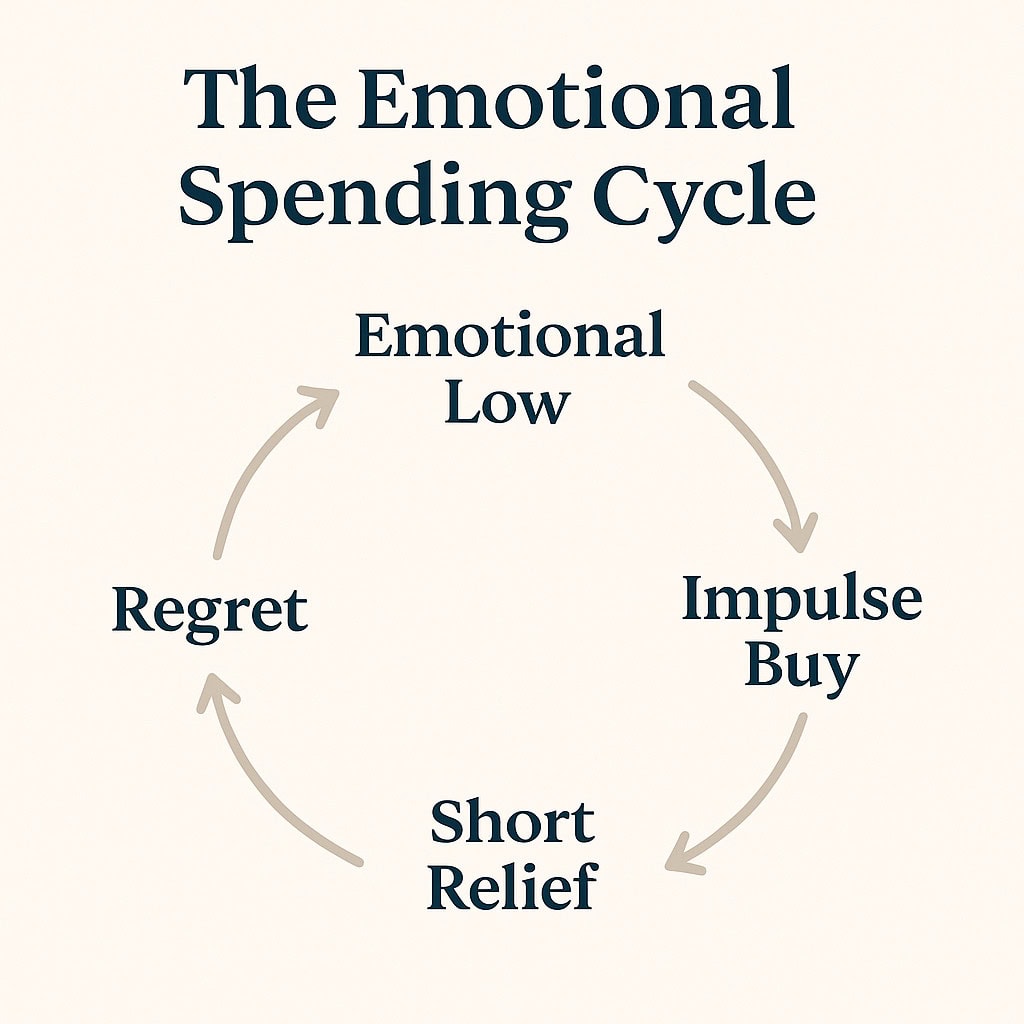
Feel bad → buy something small → feel better → regret it → repeat.
The first step to breaking the cycle?
Start noticing when it happens—and why.
Because once you know the pattern, you can start changing it.
The Emotional Spending Guilt Cycle
Emotional spending doesn’t stop with one purchase.
You buy something to feel better, but you never use it.
Every time you see it, guilt surfaces.
Yet you keep it—because “I already spent the money… maybe I’ll wear\ use it someday.” Right?
Except you don’t.
Clutter grows.
Overwhelm deepens.
To numb it, you repeat the cycle.
The emotional toll is real
This isn’t just clutter—it’s emotional weight that erodes your money mindset, your peace, confidence, and savings.
- You’ve bought a dress that doesn’t fit “yet”—only to feel bad twice over because 1 year later you still don’t fit into it.
- You’ve spent $45 on a blush that’s no better than your old one because everyone on TikTok was talking about it.
- You’ve purchased a Cricut machine you never use. Now it sits there as a $500 guilt lump in your home.
Sound familiar?
Here’s the hard truth: the money is already gone.
Holding onto things out of guilt won’t bring it back—it just reminds you of what you didn’t need.
There’s a reason why a hotel room always feel so calm and relaxing. Its because there’s no untouchable makeup, no unworn clothes reminding you of the money that you spend but never use.
Just clean, minimal space. With no guilt attach to it.
You deserve that in your own life.
Start by asking yourself:
- What purchases haunt me?
- What am I afraid to let go of?
- What would peace feel like in my space?
Once you spot the pattern of emotional spending, you can begin rewriting it. Then invest in experiences or items that align with your values—leading to true financial freedom and meaningful joy. It will not happened in one day and there will be setback. But those setback will be a reminder of the feeling your actually looking for.

Break the Pattern—One Decision at a Time
This is where things really start to shift.
If you’ve been stuck in the emotional spending cycle, you don’t need a total life overhaul.
You just need to start noticing. One choice at a time.
Here’s the 3-step reset that changed everything for me:
🧠 Step 1: Know Why You’re Buying
This is where your awareness kicks in.
Before you swipe your card or click add to cart, ask yourself:
- Did I just have a hard day and want a little pick-me-up?
- Am I feeling bored, overwhelmed, or low?
- Am I craving control, connection, or comfort?
There’s always a reason—and once you can name it, you start taking your power back.
You’re not just buying for the sake of it. You’re trying to feel something.
But the more you understand those patterns, the easier it gets to shift them.
It’s the first step toward mindful awareness of your spending patterns.
✍️ Step 2: Get Clear On What You Actually Want
Here’s where you stop spending on “meh” and start saving for wow.
You don’t need to remove the rush—you just need to upgrade it
Ask yourself:
What are the few things you own that actually make you feel amazing?
That’s the vibe we want more of.
Try this:
If you had one hour to pack up your life and move, what would you take with you?
What would be a “hell yes”—and what would get left behind?
The answers to those questions? That’s your real style.
That’s your standard.
Now go deeper—start your Dream List.
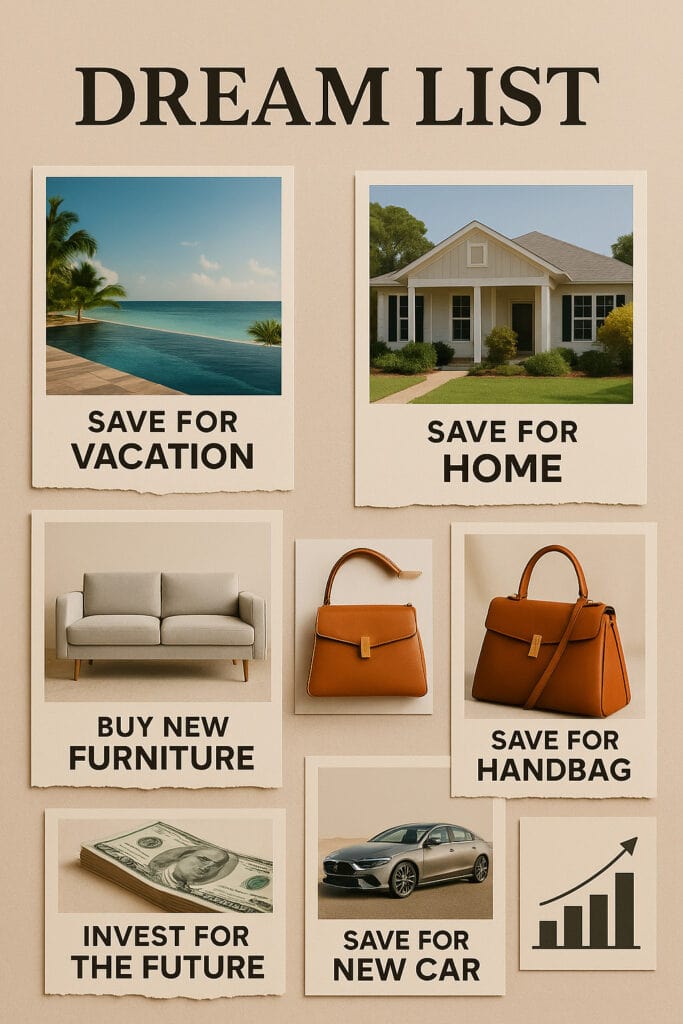
Write down 10 things (experiences, items, even savings goals) you truly want but haven’t allowed yourself to have. These aren’t impulse wants. These are the hell yes things that make you feel more like you.
Your Dream List is more than just a Wishlist—it’s your filter.
It helps you pause. It gives you something to look forward to.
It keeps you focused on what actually matters.
⏳ Step 3: The 48-Hour Rule
This rule alone saved me thousands.
Here’s how it works:
Whenever you feel the urge to buy something that’s not essential—pause.
Wait 48 hours. Give yourself space to want it on purpose.
Ask yourself:
- Is this something I truly want, or was it just looking for a dopamine rush?
- Is this on my Dream List—or is it just a distraction?
- Would I still buy this at full price?
You’ll be surprised how often that dopamine rush fades—and so does the desire.
Because once the stress passes and the emotion wears off… the item just doesn’t feel worth it anymore.
The 48-hour rule isn’t about depriving yourself.
It’s about buying with intention—not impulse.
💡 What Helped Me Most (My Personal Trick)
Here’s what finally clicked for me:
I didn’t actually want more stuff.
I felt overwhelmed in my own apartment—surrounded by clothes I didn’t love and things that didn’t really feel like me. I kept settling for the cheaper option, telling myself I couldn’t afford better… but honestly? I just didn’t believe I deserved it.
But deep down?
I wanted the Aritzia blazer that actually fit and made me feel powerful.
I wanted the European summer vacation every year.
I wanted to invest, save, and retire early—not keep buying things that left me feeling meh.
That shift didn’t happen overnight, but this is what helped me break the cycle:
- I got honest with myself.
- I created a Dream List—a list of things I actually wanted, not just what was on sale.
- I started using the 48-hour rule like my life depended on it (honestly… my savings did).
- I focused on spending in ways that moved my life forward—not just gave me a quick high.
✍️ Try This Quick Reset Exercise:
- List 5 things you really want but haven’t allowed yourself to buy.
- Then ask: What would having this actually make me feel?
Calm? Confidence? Joy? Freedom? - Now look back at your purchases from the last week.
Do they reflect the life you say you want? Or are they just temporary fixes?
Here’s the truth: most of us aren’t buying things—we’re chasing a feeling.
The trick is learning to name the feeling, so you can choose something that actually satisfies it.
🎯 This Isn’t About Cutting Joy. It’s About Choosing Better.
I’ll never be the girl who tells you to skip your $5 latte if that’s what lights you up. (I’m definitely never giving up mine.)
But the 17th pair of biker shorts you almost bought because they were on sale?
Yeah… that’s where I had to check myself. (And trust me, that’s still my weak spot.)
That money?
It could be fueling your next trip, padding your savings, or buying you back your time.
✨ So ask yourself:
What’s your version of the biker shorts?
And what could your life look like if you stopped chasing the rush… and started building the version of your life that actually feels good?
Final Journal Prompt:
- What are 3 things you truly want but haven’t let yourself have?
- What would having them make you feel?
- Would those purchases feel like alignment—or escape?
If that sparks something in you, that’s your cue.
This journey isn’t about perfection—it’s about intention.
You’re allowed to want more—but let’s make sure it’s the right kind of more.
Wants more question to ask yourself if your next purchase is an impulse buy or not? Read the 5 signs to recognize if your about to impulse buy?
[insert relevant read more block here]