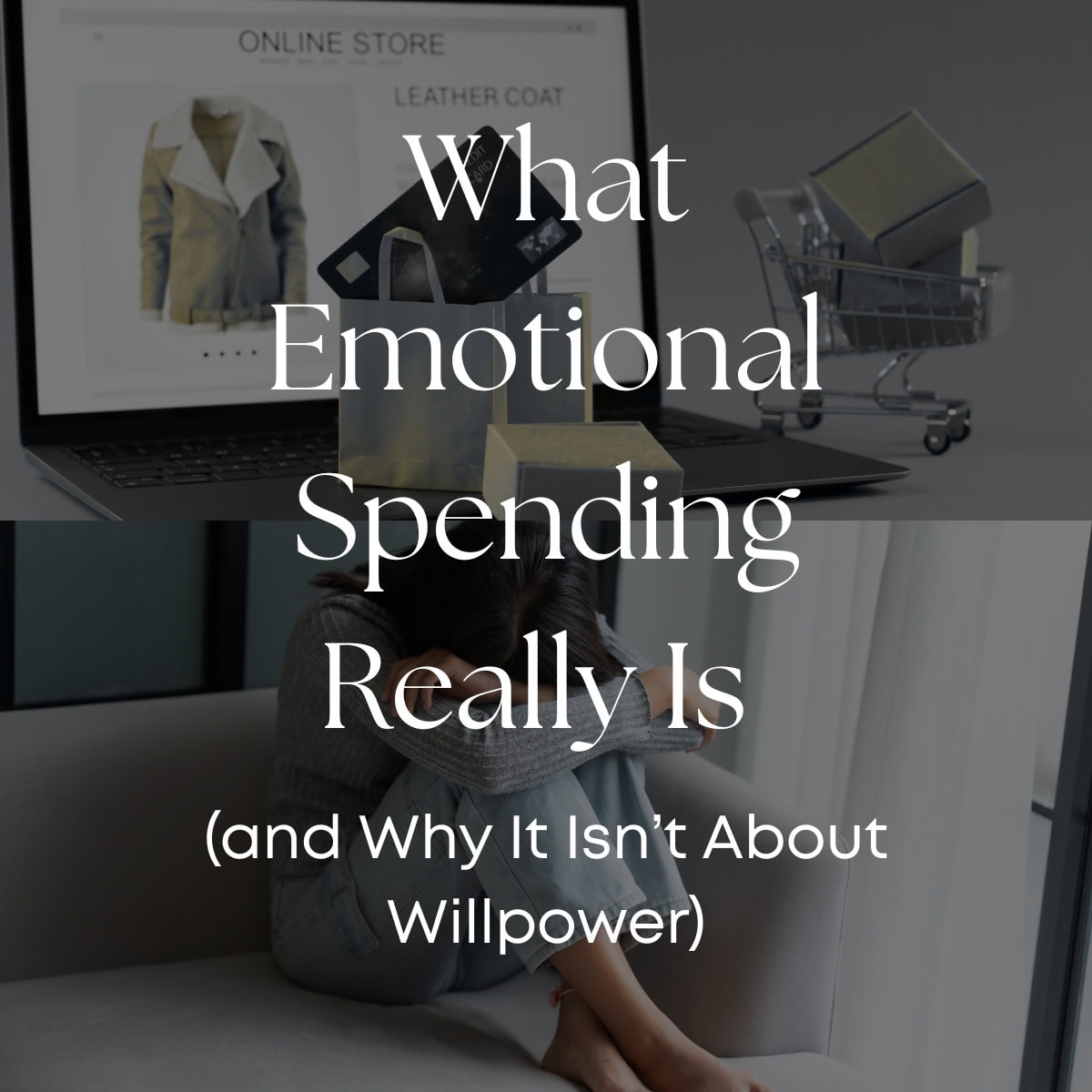
What Emotional Spending Really Is (and Why It Isn’t About Willpower)
Have you ever promised yourself you’d stop buying clothes or makeup for the next month…
only to place another order three days later?
Or walked into a store for one thing and somehow left with a bag full of “extras”?
Most people assume this means they lack discipline, willpower, or are “just bad with money.”
So they buy another budgeting spreadsheet thinking it will magically fix everything.
Spoiler: it won’t.
Here’s the truth: Emotional spending has almost nothing to do with willpower — and everything to do with your nervous system trying to regulate an uncomfortable emotion.
If you’ve been wondering why you keep doing it or why it feels impossible to “just stop,” this post will show you the real psychology behind emotional spending — in a way most people have never been taught.
And who am I to walk you through this?
Because I used to be the poster child for emotional spending.
I couldn’t go more than three days without buying something new.
But once I finally learned what my spending was trying to tell me, everything changed.
I tripled my savings, stopped drowning in clutter, and built a life that actually feels like mine.
Let’s dig into the truth no one ever explains.
What Emotional Spending Actually Is (Not What You’ve Been Told)
Most people think emotional spending is buying things when you’re sad or stressed.
But it goes much deeper.
Emotional spending is any purchase you make to shift your internal state.
That includes things like:
- Buying something to feel more confident
- Shopping to feel “put together”
- Grabbing a small treat after a long day
- Buying when you’re overstimulated and need to escape
- Shopping because you’re mentally drained (even if you’re not consciously upset)
It’s not “retail therapy.”
It’s emotional regulation.
Shopping becomes a tool to:
- calm anxiety
- create excitement
- distract from discomfort
- feel productive
- feel worthy
- feel in control
So when you emotionally spend, you’re not being reckless.
You’re trying to rebalance yourself — just in a way that doesn’t last.
Here’s what most people miss:
Emotional spending isn’t a financial problem first.
It’s an emotional coping strategy.
Shopping is simply one of the quickest, easiest “fixes” your brain knows how to reach for.
This means emotional spending isn’t irresponsibility.
It’s a sign your emotions need support — not your willpower.

Its Not About A Lack Of Willpower Or Discipline
We’re taught that a spending problem equals a discipline problem.
But the truth is:
You can’t use willpower to override your nervous system.
When you’re emotionally overwhelmed, your brain goes into survival mode.
Logical decision-making drops.
Impulse control disappears.
This is why:
- you can budget perfectly and still impulse buy
- you can promise yourself “never again” and still do it
- you can be financially smart but emotionally exhausted
Willpower is temporary.
But your emotional needs are constant.
When you’re tired, overstimulated, lonely, or mentally drained, willpower is the first thing to collapse.
So no — you’re not weak.
You’re not irresponsible.
You’re not “bad with money. ”You’re human, and your brain is just trying to help you feel okay — quickly.

The Deeper Psychology Behind Emotional Spending (And How It Shapes Your Impulse Buying)
Emotional spending rarely comes from surface-level feelings.
It comes from deeper emotional patterns that have been shaped over years.
Here’s what’s really happening:
A. You’re seeking emotional relief, not the item
The purchase represents hope, ease, escape, or a better version of yourself.
B. You’re avoiding emotional discomfort
Your brain doesn’t want you to sit with discomfort — it wants to solve it right now.
Shopping gives you 3–10 minutes of relief.
C. Your brain prioritizes “now” over “later”
Long-term financial goals disappear when your emotions are activated.
D. Purchases become emotional placeholders
You’re not buying the thing.
You’re buying a fantasy. A mood. A moment of confidence. A feeling of progress.
E. Emotional overload reduces decision capacity
When you’re stretched thin, your brain simply has less space to make rational choices.
None of this means you’re irresponsible.
It means you’re overwhelmed.
And until you understand what emotion you’re trying to soothe or replace, no budget, no spreadsheet, and no “no-spend month” will ever solve the problem.
Once you learn to recognize your emotional triggers, resisting the urge becomes so much easier — because you finally understand what the impulse is trying to tell you. And yes, you can have more than one trigger, and they will shift over time.
Staying aware of your feelings is the only way to stay a step ahead of them.

Everyday Examples Of Emotional Triggers (Without Judging You)
Emotional spending doesn’t always look dramatic.
Sometimes it’s subtle — almost invisible.
Here are the most common ones:
The “I deserve this” buy
A long, exhausting day leads to a small treat so the day doesn’t feel wasted.
The “this will fix everything” buy
The new planner, skincare routine, or organizational tool feels like a solution to your stress.
The “everyone else has it” buy
A trend makes you feel left out, so you buy it to feel aligned.
The “I need to feel something” buy
You’re bored or numb, so shopping gives you a quick burst of excitement.
The “future me will use it” buy
You’re buying a fantasy version of yourself, not your reality.
These aren’t failures.
They’re clues. They’re messages your emotions are quietly trying to send you.
Emotional Spending Isn’t the Problem — It’s the Signal
At its core, emotional spending isn’t a money issue.
It’s a message.
A signal that:
- you’re tired
- overwhelmed
- under stimulated
- overstimulated
- avoiding something
- craving comfort
- or just trying to feel okay
Instead of judging yourself, start listening to the signal.
Your emotions aren’t trying to sabotage you — they’re asking for support.
So what are they telling you?
And if you’re ready to take the next step and actually break the cycle (without shaming yourself or relying on willpower), I recommend that you read How to Break the Cycle of Emotional Spending